
In 2026, the landscape of head protection is shifting from the traditional “Hard Boiled Hat” legacy of 1919 toward modern, high-tech safety helmets. While the core mission of the Occupational Safety and Health Administration (OSHA) remains the same, the standards for compliance have evolved to address multi-directional impact risks.
This guide provides a comprehensive overview of the latest ANSI/ISEA Z89.1 standards, the industry-wide move toward Type II protection, and the critical hard hat color codes used to maintain on-site communication. Whether you are a general laborer or a safety inspector, staying current on these 2026 updates is essential for preventing traumatic brain injuries and avoiding costly OSHA violations.
Need to Get Compliant? We offer comprehensive OSHA Safety Training for individuals to ensure you have the credentials and knowledge to stay safe on any job site.

What’s New in 2026: The Shift to Safety Helmets
The most significant trend in 2026 is the rapid adoption of Type II safety helmets over traditional Type I hard hats.
The Rise of Type II Protection
While OSHA hasn’t yet issued a universal mandate for all private employers to switch, the agency officially transitioned its own personnel to safety helmets in recent years. Many major contractors are now requiring Type II helmets by 2026 because:
-
Lateral Protection: Unlike Type I hats (top-only), Type II helmets protect against impacts to the front, back, and sides.
-
Integrated Chin Straps: These ensure the protection stays on the head during a fall or a secondary impact.
-
Modern Standards: They meet the rigorous ANSI/ISEA Z89.1-2014 (R2019) criteria.
Improved Fit Mandates
OSHA now emphasizes a “proper fit” approach. A “one-size-fits-most” strategy is often insufficient. If a hard hat or helmet does not sit securely on a worker’s head, it may be cited as a PPE violation during an inspection.
Hard Hat Classifications (G, E, and C)
Understanding the electrical and impact ratings is the foundation of head safety. These designations remain the industry standard in association with ANSI.
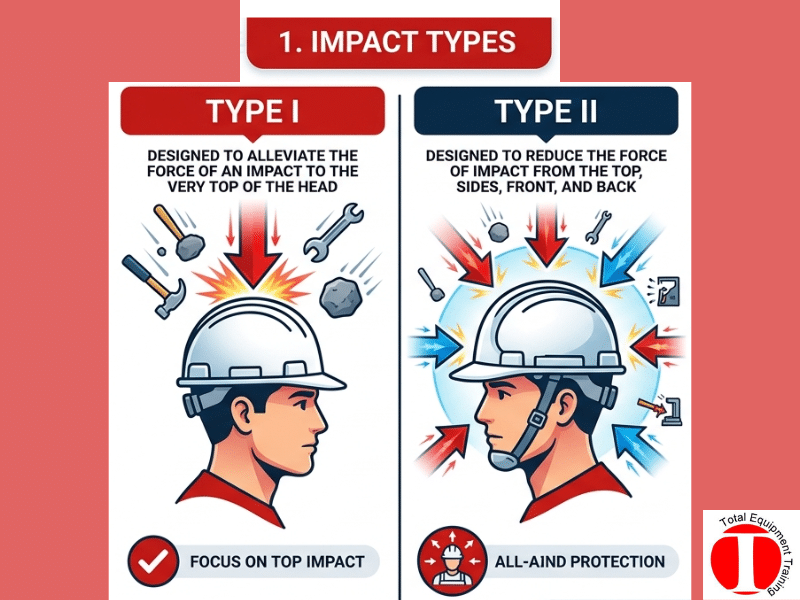
1. Impact Types
-
Type I: Designed to alleviate the force of an impact to the very top of the head.
-
Type II: Designed to reduce the force of impact from the top, sides, front, and back.
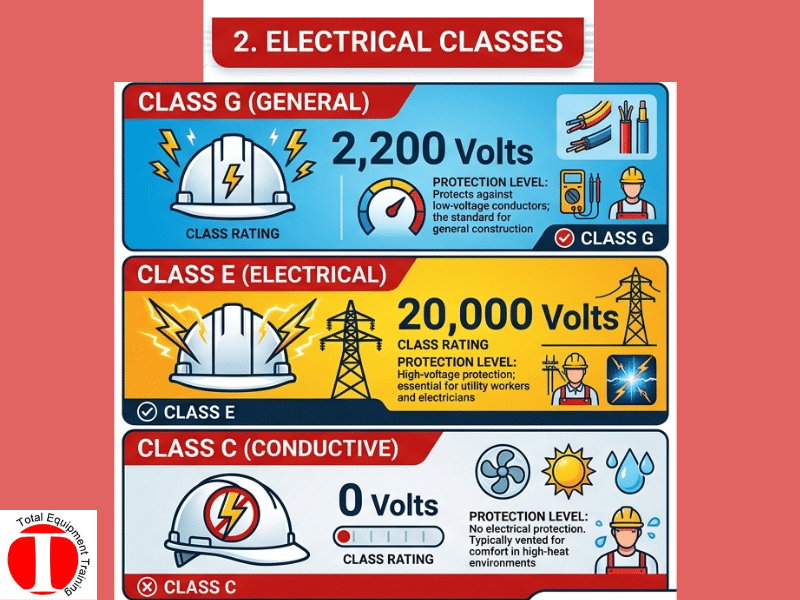
2. Electrical Classes
| Class | Rating | Protection Level |
| Class G (General) | 2,200 Volts | Protects against low-voltage conductors; the standard for general construction. |
| Class E (Electrical) | 20,000 Volts | High-voltage protection; essential for utility workers and electricians. |
| Class C (Conductive) | 0 Volts | No electrical protection. Typically vented for comfort in high-heat environments. |
Corporate Safety Solutions: We provide OSHA-compliant employee training for heavy equipment companies to help your team master these regulations and implement onsite safety protocols.
Hard Hat Color Code Meanings
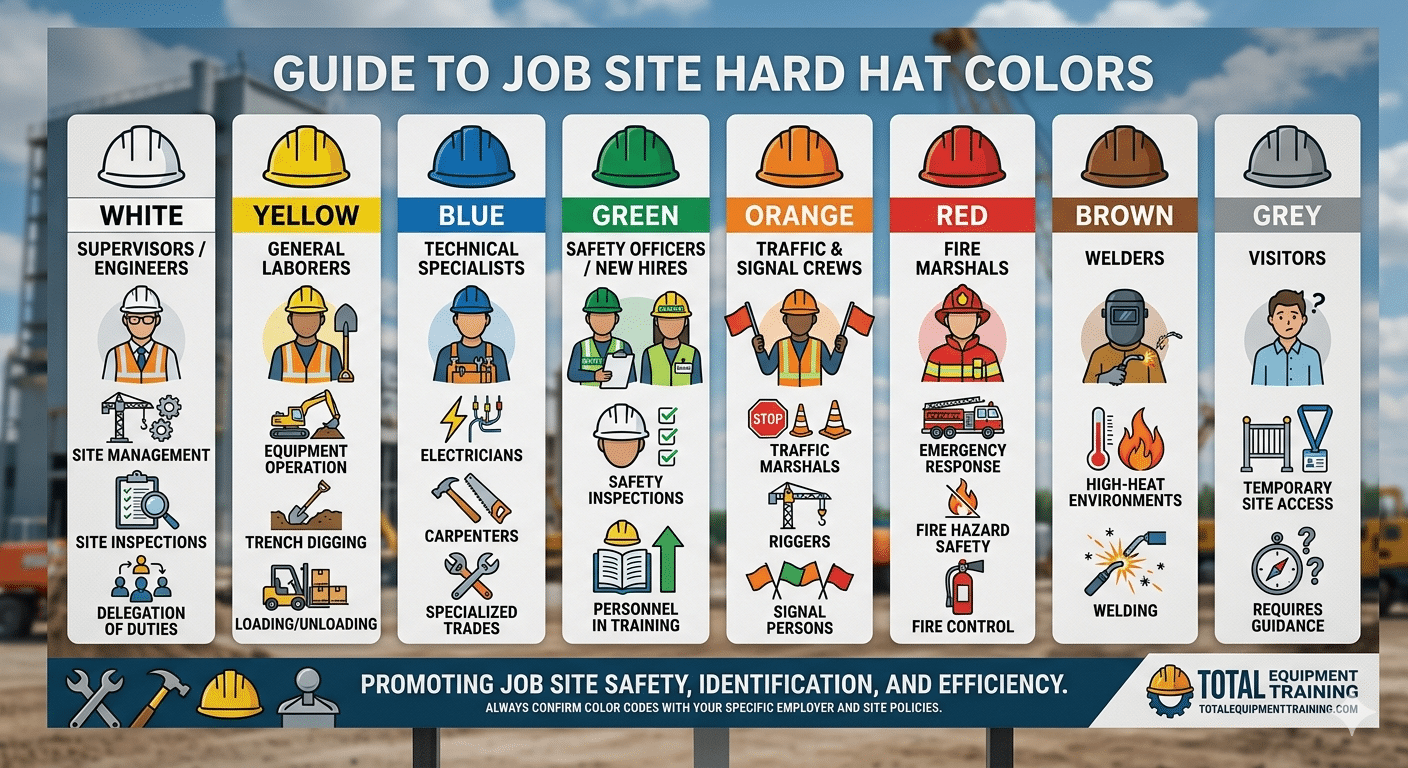
While OSHA does not legally mandate specific colors, the industry has standardized them to improve site efficiency and emergency response times.
| Color | Wearer Type | Typical Duties |
| White | Supervisors / Engineers | Management, site inspections, and delegation. |
| Yellow | General Laborers | Earth-moving, equipment operation, and heavy lifting. |
| Blue | Technical Specialists | Electricians, carpenters, and specialized trades. |
| Green | Safety Officers / New Hires | Safety inspections or personnel in training. |
| Orange | Traffic & Signal Crews | Road crews, riggers, and high-visibility roles. |
| Red | Fire Marshals | Emergency response and fire hazard management. |
| Brown | Welders | High-heat applications and welding. |
| Grey | Visitors | Temporary site access; requires guidance from site staff. |
Risks of Non-Compliance in 2026
Ignoring head protection standards carries severe consequences. In 2026, OSHA has increased its focus on inspection and maintenance.
-
Financial Penalties: As of 2026, serious OSHA violation fines can exceed $16,000, while willful or repeated violations can surpass $161,000.
-
Accessory Compatibility: Attaching unapproved lights, cameras, or face shields to a helmet can void its ANSI rating and lead to a citation.
-
Physical Trauma: Traumatic brain injuries (TBIs) remain a leading cause of workplace fatalities. Type II helmets are specifically designed to reduce the rotational force that causes concussions.
The 2026 Inspection Checklist
Before every shift, workers must inspect their headwear for:
-
Cracks or Dents: Any visible compromise to the shell.
-
Suspension Wear: Fraying or damage to the internal webbing.
-
UV Degradation: A “chalky” appearance or brittle texture from sun exposure.
-
Expiration: While OSHA doesn’t set a hard date, most manufacturers recommend replacing the suspension every 12 months and the shell every 5 years.
Professional Safety and PPE Training
Hard hats are only effective when used as part of a total safety strategy. At Total Equipment Training, we provide the expert guidance needed to navigate the complexities of 2026 OSHA standards. From qualitative inspection services to tailored onsite curriculums, we ensure your team is both safe and compliant.
