

Crane accidents remain one of the leading causes of serious injuries and fatalities on construction, manufacturing, and industrial jobsites. Whether involving mobile cranes, overhead cranes, or boom trucks, these incidents result in severe equipment damage, project delays, heavy OSHA penalties, and devastating loss of life. The reality is that most crane accidents are preventable. The majority of worksite incidents stem from operator error, improper rigging, poor site conditions, or inadequate training. Employers who invest in proactive, OSHA-compliant heavy equipment training significantly reduce risk while improving overall jobsite safety and productivity.
At Total Equipment Training, companies across the United States rely on our experienced instructors for specialized onsite programs, including comprehensive crane operator training, signal person training, safety consulting, and rigger certification programs tailored specifically to your workforce.
Critical OSHA & BLS Crane Accident Statistics
Data from the U.S. Bureau of Labor Statistics (BLS) and the Occupational Safety and Health Administration (OSHA) highlights the ongoing risks associated with improper crane operation:
-
Struck-By Hazards: Just over half (52%) of all fatal crane injuries involve a worker being struck by an object or equipment, frequently falling from a crane or put in motion by the crane.
-
The Leading Killers: According to historical OSHA and BLS data, the top three leading causes of crane-related fatalities are overhead power line electrocutions (approx. 32%), crane collapses (21%), and workers being struck by a crane boom or jib (18%).
-
Primary Locations: The majority of fatal crane incidents occur on non-roadway construction sites (27%), followed closely by manufacturing factories and industrial plants (24%).
-
Industry Impact: The private construction industry accounts for 43% of all crane-related fatalities, with specialty trade contractors and heavy civil engineering construction bearing the highest risk.
When a crane incident occurs, the fallout goes far beyond the immediate physical danger. Employers often face severe financial and operational disruptions, including costly equipment damage, strict project shutdowns, personal injury lawsuits, and compounding OSHA citations and fines.
What Are the Top 5 Common Causes of Crane Accidents?
According to workplace injury and fatality data collected by the U.S. Bureau of Labor Statistics (BLS), crane incidents stem from very specific visual and operational failures. Ranked from the most frequent to least frequent primary events, here are the top five common causes:
1. Falling Loads & Struck-By Accidents
Dropped loads and falling equipment create immediate, devastating crushing hazards for any personnel working on the ground below.
-
The Stat: According to official data from the Bureau of Labor Statistics, just over half (52%) of all fatal crane injuries involve a worker being struck by an object or piece of equipment. Of those struck-by cases, nearly three-fifths involved an object falling directly from or put in motion by the crane.
-
Common Causes: Improper rigging configuration, utilizing worn or damaged hooks or wire ropes, sudden crane movements, and letting workers stand directly inside the fall zone.
-
How to Prevent It: Utilize only qualified riggers, implement mandatory daily rigging checks, perform controlled practice lifts for complex loads, and enforce strict “no-go” zones directly beneath any suspended load. Employers can streamline these daily equipment assessments by using downloadable, pre-formatted free heavy equipment inspection forms to guarantee regulatory compliance before every lift.
2. Contact With Power Lines & Electrocutions
Electrocution occurs when a crane structure interfaces with overhead utility grids, traveling down the machinery to ground personnel.
-
The Stat: Historical BLS census data indicates that overhead power line contact is the single most frequent environmental cause of crane-related fatalities, accounting for roughly 25% to 32% of all tracked crane deaths.
-
Common Causes: Operating too close to overhead utilities, lack of dedicated spotters, poor site planning, and failure to identify minimum clearance distances.
-
How to Prevent It: Always maintain OSHA-required clearance distances, treat all overhead lines as energized, implement trained spotters, and de-energize or shield power lines whenever operations must occur nearby.
3. Crane Tip-Overs & Collapses
Boom collapses and structural crane overturns are catastrophic events that destroy surrounding jobsite infrastructure and risk the lives of operators and ground crew alike.
-
The Stat: Crane collapses represent the next leading event category, accounting for approximately 14% to 21% of all documented crane fatalities on active worksites.
-
Common Causes: Improper or incomplete outrigger deployment, setting up on uneven or soft ground, failing to adjust for high winds, and exceeding the crane’s technical load charts.
-
How to Prevent It: Conduct thorough ground inspections before setup, utilize proper crane mats or cribbing, fully deploy all stabilizers, closely monitor weather conditions, and ensure operators are expert at reading and adjusting for load charts.
How to Read a Crane Load Chart
4. Mechanical Failure
Heavy equipment components experience continuous structural stress and mechanical wear. Without rigorous tracking, component fatigue can lead to rapid machine failure.
-
The Stat: Mechanical failures and hardware compromises consistently trigger a major percentage of secondary exposures, frequently overlapping with struck-by incidents when a hoist cable or hook breaks under tension.
-
Common Causes: Neglecting regular equipment maintenance, ignoring hydraulic system leaks, operating with worn wire ropes, brake failure, and failing to act on daily inspection findings.
-
How to Prevent It: Mandate thorough daily operator inspections, schedule annual crane inspection services from qualified professionals, replace worn components immediately, and keep meticulous maintenance records.
5. Human Error & Lack of Training
At the root of nearly every line item on this list is a fundamental breakdown in basic jobsite communication, machine positioning, or technical load calculation.
-
The Stat: Over 22% of all crane fatalities occur precisely when a worker is actively operating the crane machinery, pointing to a severe, ongoing need for enhanced hazard recognition skills at the controls.
-
Common Examples: Misreading or miscalculating load charts, utilizing non-standard hand signals, improper rigging selection, and rushing operations to meet tight project deadlines.
-
How to Prevent It: Provide documented, OSHA-compliant heavy equipment training, verify qualifications for all ground crew, and foster an on-site culture where safety always takes priority over speed.

Comprehensive OSHA Safety Training for Your Workforce
Preventing crane accidents requires a holistic approach to jobsite safety that goes beyond basic machine operation. Total Equipment Training provides specialized OSHA safety training certification for you or your staff. As the primary U.S. agency responsible for setting and enforcing strict workplace standards, OSHA ensures safe and healthful working conditions across all industrial sectors.
To help your company maintain total compliance and protect its personnel from the most frequent workplace hazards, we provide dedicated OSHA training for the following critical areas:
-
Confined Space Training: Equip your team to safely identify, test, and enter permit-required confined spaces while understanding proper rescue protocols.
-
Fall Protection Training: Learn how to properly select, inspect, and utilize personal fall arrest systems (PFAS), guardrails, and safety nets to eliminate high-elevation hazards.
-
Lockout Tagout (LOTO) Training: Prevent unexpected machine startups or releases of hazardous energy during equipment service and maintenance.
-
Scaffolding Training: Ensure all scaffolding systems are properly erected, inspected, and utilized by competent persons to avoid dangerous structural failures.
By bringing professional instructors directly to your facility, you receive customized instruction built around your specific workflow, enabling your crew to train on the exact equipment and unique conditions they encounter every day.
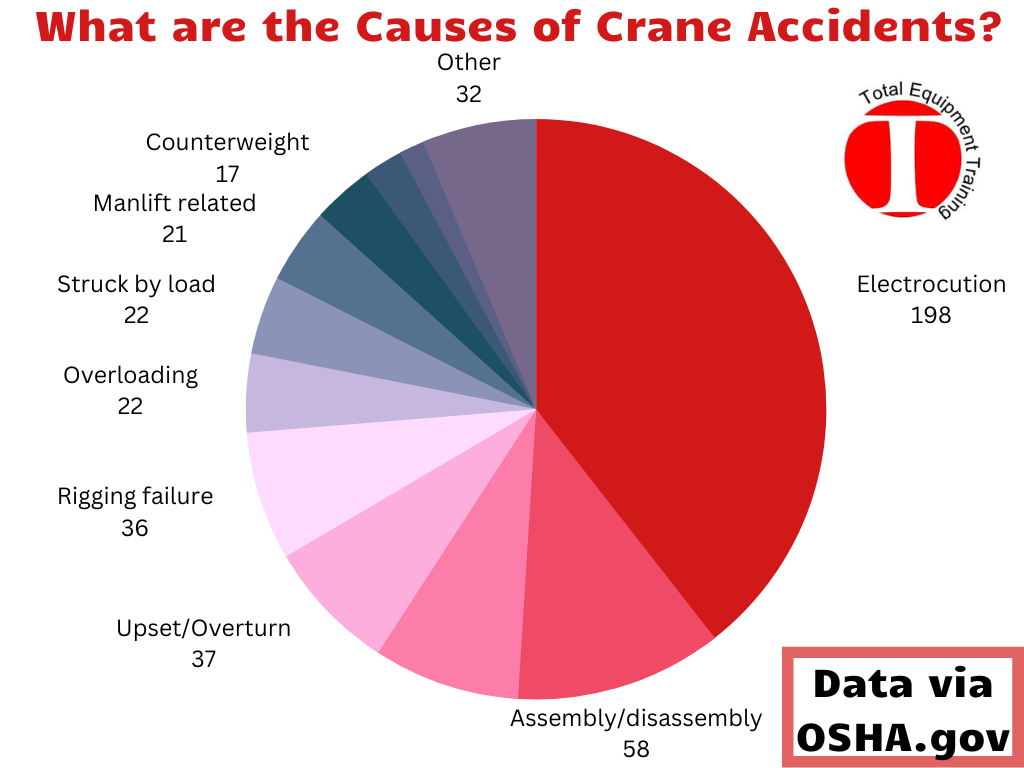
OSHA Crane Accident Statistics
OSHA has identified the following as the most common/major causes of crane accidents:
- The crane or its boom coming into contact with live power lines (39%)
- Crane assembly/disassembly (12%)
- Boom buckling/collapse (8%)
- Crane upset/overturn (7%)
- Rigging failure (7%)
- Overloading (4%)
- Struck by moving load (4%)
- Man-lift related accidents (4%)
- Working within radius of counterweight (3%)
- Two-blocking (2%)
- Hoist limitations (1%)
- Other causes (6%)
Prevent a Crane Accident Today: Schedule with Total Equipment Training
Ready to elevate your jobsite safety and ensure complete compliance? Total Equipment Training is here to support your team with the industry’s leading educational and operational solutions. Equip your operators for career advancement and testing success with our comprehensive, specialized NCCCO study materials, or eliminate logistical headaches by scheduling onsite training for your company to have our expert instructors train your crew directly on your own equipment. Don’t wait for a costly accident or an unexpected citation to address your safety gaps—partner with Total Equipment Training today to protect your workforce, maximize operational efficiency, and build a culture of compliance.
