
Note: According to OSHA, every operator must have access to the load chart at all times. This article has been updated for accuracy and comprehensiveness for May 2026.
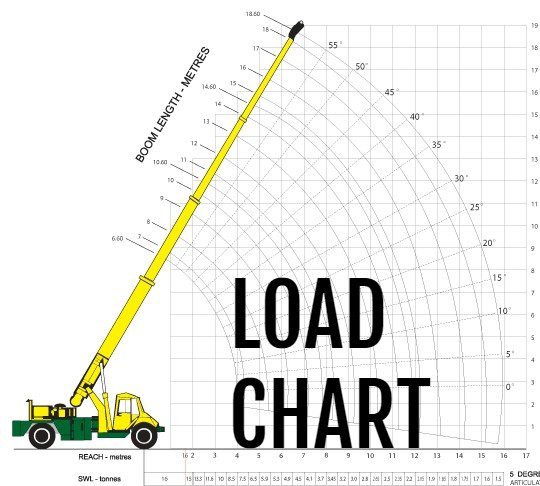
A crane load chart is an essential tool for operators to calculate a machine’s lifting capabilities. This chart serves as a primary safety reference, ensuring the crane does not exceed its mechanical or structural limits. Capacity is not a fixed number; it varies significantly based on distance, boom length, and angle.
Crane Load Testing: Safety and Compliance
What is Crane Load Testing?
Crane load testing is a mandatory safety procedure verified by OSHA and ASME to confirm a crane’s ability to handle its rated capacity. This process validates that the machine can manage its maximum designed weight, preventing catastrophic structural failure. Load testing is required for:
-
New equipment: Before initial use.
-
Modified equipment: Following significant repairs or structural alterations.
-
Periodic inspections: Depending on the severity of use and local regulations.
Importance of Regular Testing
Prioritizing regular crane load testing services alongside comprehensive onsite heavy equipment training enhances workplace efficiency. Key benefits include:
-
Structural Verification: Confirms the integrity of hoists, hooks, and booms.
-
Operator Confidence: Provides the operator with documented proof that the equipment functions properly under its rated load.
-
Risk Mitigation: Significantly reduces the likelihood of tip-overs or mechanical breakdowns.
Regulatory Standards
Testing procedures typically adhere to ASME B30 standards, including:
-
B30.10: Hooks
-
B30.20: Below-the-hook lifting devices
-
B30.16: Overhead hoists
Following the physical test, technicians perform a non-destructive inspection to identify hairline fractures or defects. A detailed report is then generated for compliance records.
Frequency and Methods
The frequency of testing is dictated by usage frequency, environment, and maintenance history. One modern advancement is the use of Water Bags. These are a safe, cost-effective alternative to solid weights, allowing for gradual load application to identify potential issues before reaching full test weight.
How to Read a Crane Load Chart
Understanding a load chart requires mastering several technical variables. If an operator misinterprets even one of these, the risk of a tip-over increases. For those preparing for exams, utilizing mobile crane study guides for CCO certification can help clarify these complex charts.
1. Lift Capacity
The total weight a crane can handle at a specific configuration, including the load and all rigging.
2. Lift Range (Load Radius)
The horizontal distance from the center of the crane’s rotation to the center of the load. As the radius increases, the lifting capacity decreases.
3. Boom Angle
The measurement between the centerline of the boom and the horizontal plane. Generally, a higher boom angle allows for a higher lifting capacity.
4. Range of Motion and Quadrants
Cranes must often rotate (swing) to complete a lift. Charts specify capacities based on the quadrant of operation (e.g., over the front, rear, or 360-degree rotation).
5. Deductions (Gross vs. Net Capacity)
To find the actual weight of the material you can lift, you must subtract the weight of the crane’s accessories from the “Gross Capacity.” Common Deductions include:
-
Rigging (slings, shackles)
-
The load block and headache ball
-
The weight of the jib
The “Bold Line” and Structural vs. Stability Limits
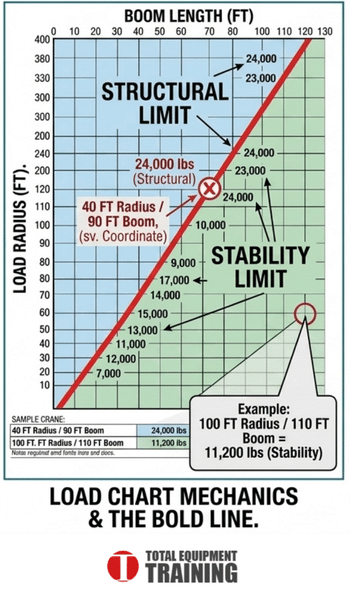
-
Above/Left of the Line: Capacities are limited by structural strength. Exceeding these values causes components to break.
-
Below/Right of the Line: Capacities are limited by stability. Exceeding these values causes the crane to tip.
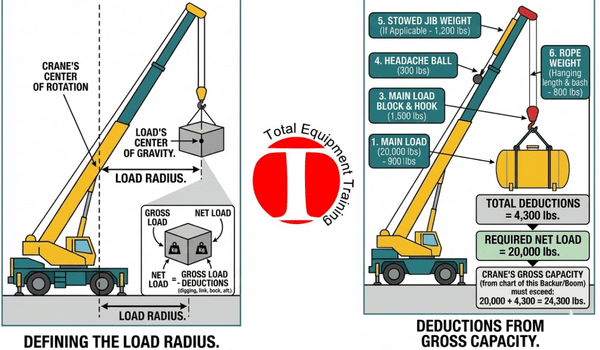
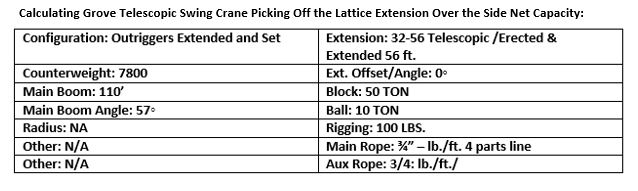
Below is an example on how to read a load chart.
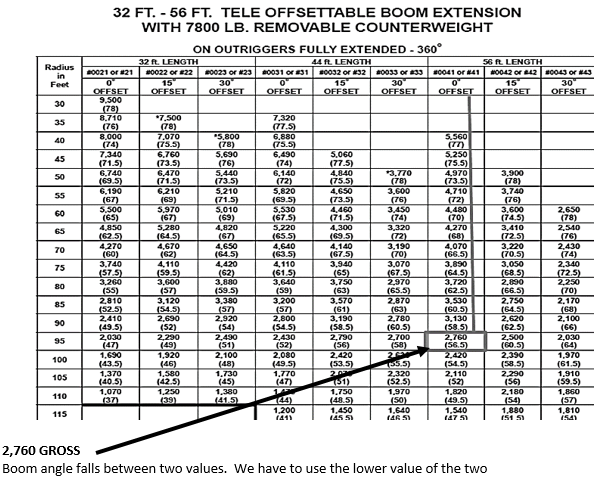
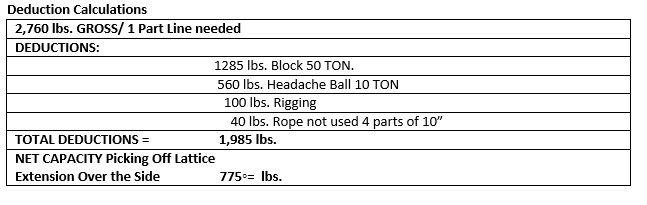
Total Equipment Training offers additional crane education resources (comprehensive hard copy crane manual) covers everything from site safety to load charts, preparing you to tackle the CCO mobile crane operator exam with confidence.
Creating a Safe Lift Plan
A well-structured lift plan is the backbone of any operation. To sharpen your skills, you can take a free heavy equipment practice test to gauge your knowledge of safety protocols.
Essential Components of a Lift Plan
-
Equipment Verification: Ensuring the crane and hardware exceed the required capacity.
-
Personnel: Clearly defined roles for operators and signal persons.
-
Hazard Assessment: Identification of power lines and ground stability.
-
Environmental Factors: Accounting for wind speeds and the “windsail” effect on large loads.
For professional heavy equipment inspections, certification, and tailored operator training, contact our team to ensure your site remains compliant and safe.
